
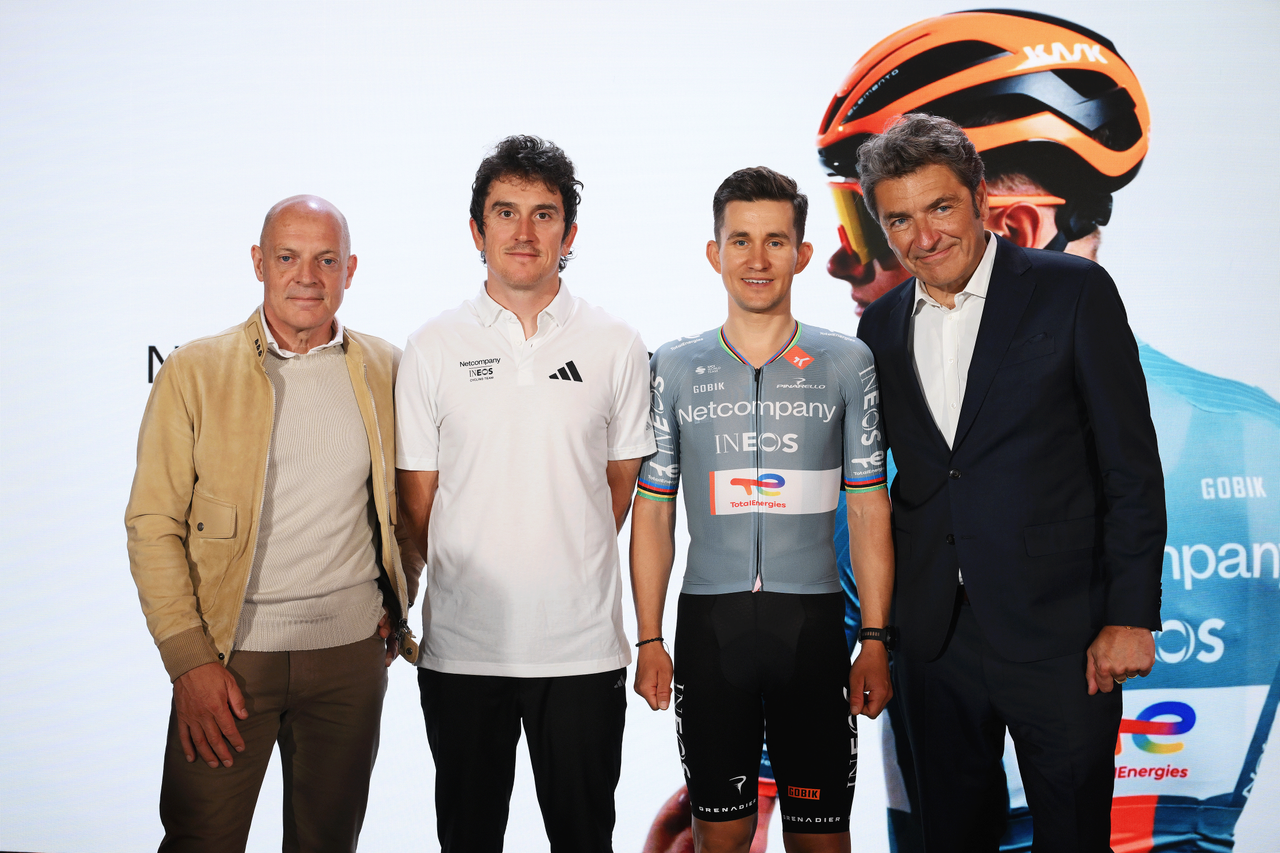
"We will win the Tour de France within the next five years," would be an ambitious statement for anyone not called Tadej Pogačar or UAE Team Emirates-XRG to make in 2026, but it was among the striking words uttered by the CEO of Ineos' new co-title sponsor on Tuesday.
His name is Andrej Rogaczewski, co-founder and CEO of Netcompany, a rapidly growing AI technology leader in Europe that has entered cycling with big money – reportedly €100 million over five years – and grand ambitions to both optimise Jim Ratcliffe's British team and return them to former yellow jersey-winning glory.
"I think we can really prevail here. We will win the Tour de France for the eighth time within the next five years," emphasised Rogaczewski in his initial address.
"So if you haven't heard about us yet, you will certainly now, because with Netcompany and Ineos, and what happens really when you marry an IT company, digitisation and AI, AI, AI with the most winning professional cycling team in the world, of course, you get a big force of cycling in tech, but what we will achieve here is a mean winning machine."
Sir Dave Brailsford is also back at the helm and finally back with a media-facing job title at the cycling team after his return during last year's Tour. Brailsford was announced on stage at Via Atelier in London on Tuesday as Team Principal of Netcompany Ineos Cycling Team and still Director of Sport at Ineos.
Brailsford and Rogaczewski both spoke about the 'blizzard of data' there is to tackle in modern cycling, with Netcompany's PULSE AI platform – which is used to optimise operations at major airports such as London Heathrow – set to be used in pursuit of greater efficiency and performance.
But can AI really help win them the Tour de France?
They obviously don't have Pogačar, but Netcompany-Ineos are also without any of recent his closest GC rivals, like Jonas Vingegaard, recent podium finishers Remco Evenepoel and Florian Lipowitz, or the top young rider in the sport, Paul Seixas.
The latest race content, interviews, features, reviews and expert buying guides, direct to your inbox!
The last time Ineos finished on the podium of the Tour was with Geraint Thomas in 2022, who sat on stage in a polo shirt, not the new kit, having recently retired.
Brailsford thinks the genetic gap to the likes of Pogačar and the rising French star Seixas, two riders whom he singled out, can be closed, with Netcompany Ineos extracting every bit of human performance possible with the help of science and artificial intelligence.
"This partnership gives us that opportunity to really think further ahead. Like Andre, we're not scared of setting big, ambitious goals. We always look at the biggest prize in our sport and think, if you're going to go for anything, you should go for that," said Brailsford.
"It's an interesting place for the sport because clearly there's one guy who is pretty good at the minute. There's another very young guy who is also pretty good, and everybody could just say, 'Well, that's it, let's shut up shop, game over'. I don't believe that."
Driven by the goal of closing that gap to the Pogačars of the world, Brailsford draws inspiration from Roger Bannister, Sabastian Sawe and Yomif Kejelcha in the hope that cycling's next stars will keep coming, and that one of them will be among his team's ranks.
"I think Seixas is fantastic for the sport, and you're always going to have somebody who's out there, and you've got to close the gap to who drives you. So you might not have someone with the same genetics, but with the right training and the advantage of getting everything out, absolutely squeezing every last drop of performance out, you're going to get close," he said.
"I think now we're seeing Pogačar be out on his own for a while, and Seixas coming in, with Vingegaard, too. I think it'll be a bit like a four-minute mile; when it was broken, all of a sudden, quite a few people broke it. Or like the marathon on the weekend; we [Ineos Sport] worked really hard with Eliud Kipchoge to go under the two hours [in 2019, an unofficial record], and lo and behold, somebody goes and does a 1:59.30, and then the guy who was second also goes under two, in his first ever marathon.
"It all comes at once, and I really do think that there'll be a crop of youngsters who will close that gap. I think it's coming. It's an exciting place for the sport to be, so with more insight, more information, getting more accurate, with more detail, and making more decisions right most of the time, we'll close the gap."
The 'Holy Grail' of individualisation
Brailsford believes the key to eeking out more performance thanks to the PULSE AI platform is in "individualisation", with endless metrics of data gathered on each rider being housed in one place, and action plans tailored specifically for each rider.
"I feel the next big step in the human side of endurance sports is individualisation. We're all becoming aware now that there's an individual response to training, to recovery, to nutrition and understanding that individualisation is quite difficult, but it's kind of at our fingertips at the minute," said Brailsford.
"Most teams are grappling with that, to try and take the big step of being the first ones able to really look at how AI and predictive data can allow that individualisation to take place. I think for the first people who get there, it's the Holy Grail."
Rogaczewski describes PULSE as "a platform that will unify rider conditions, environment, equipment and tactics into one AI platform," with Brailsford's big pursuit being consistency, as "getting it right day after day, that's what gets you to the top, ultimately."
On the face of it, their ambitions do seem founded on the same, somewhat divisive, marginal gains credo that characterised Brailsford's previous stint as Team Principal for Team Sky in the 2010s, but it is perhaps the monetary gains that he didn't highlight which will prove the most important part of this deal.
The freedom of a bigger budget and the role of Geraint Thomas
Fonte original: Cyclingnews