
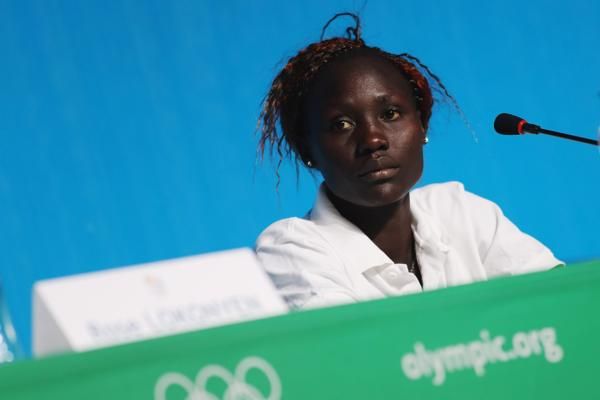
Anjelina Nadai Lohalith at a Rio 2016 Olympic Games press conference (© Getty Images)
In the lead-up to World Refugee Day on 20 June, members of the Refugee Olympic Team will be sharing their stories in a series of features as they prepare for the Games in Tokyo. The series begins with 1500m runner Anjelina Nadai Lohalith.
Last Tuesday’s confirmation that Anjelina Nadai Lohalith had been picked for the Refugee Olympic Team for a second successive Games was cause for celebration – and the 28-year-old 1500m runner duly marked the occasion at her Ngong training camp in Kenya, with much “music and dancing”.
But any day now an even more significant moment awaits as she prepares to reunite with the family she left behind when, aged nine, she escaped from her war-ravaged village in South Sudan and made her way to the vast Kakuma Refugee Camp in northern Kenya – where her father and mother have recently arrived themselves.
It will be the first time she has seen her parents since the day she and her aunt boarded a United Nations truck that had been bringing food into an area traumatically affected by a civil war that eventually ended in 2005, three years after she had reached her new home.
Recalling in a Zoom call from her training centre how the war had come to her village, Lohalith said: “Soldiers came in the night. I didn’t understand what was happening, I just heard the shooting.
“We ran to the next village and we slept in the bush at nights. We wanted to go back to our village to get food and all the things we had left behind. It was really an emergency, and we had almost nothing with us.
“But we were told we could not go back because the soldiers were occupying our village and around the village there were what they called ‘weapons underground’, which were landmines. It was not safe.
“The UN bus came with food, and that was how I was able to get out with my aunt. I thought my family would be coming after me. But they didn’t come.”
Lohalith has maintained since making the Refugee Olympic Team for the Rio 2016 Games as one of five track athletes that her “dream” was to one day help her parents.
Asked how she felt about the prospect of meeting them after so long, she paused for a few moments before saying: “It is my dearest wish.”
She added: “It makes me so happy that my parents are now in the camp. Soon we will have a welcome party!”
Already, however, her mother and father have met their grandson for the first time – Lohalith’s four-year-old son Jayden Luis Monutore.
Her parents were preceded to Kakuma by other relatives, including another of her aunts and a cousin, and they have helped to look after Jayden – already a natural runner according to his proud mum – while she has been training to make the Rio 2016 team.
“My parents don’t know about my running,” she said. “They only know about my schooling. I think it will be hard for them to understand about the Olympics. They don’t know anything about it.”
Anjelina Nadai Lohalith trains at the Refugee Athletes Centre in Ngong (© AFP / Getty Images)
Lohalith has spoken in the past of how Tegla Loroupe, Kenya’s former world marathon record-holder and three-time world half marathon winner, came to the Kakuma Camp as part of the work of her Peace Foundation and organised trial races in 2015 to identify those who might be able to run at the Olympics.
At that time Lohalith knew nothing of international athletics but she had been, like her son, a natural runner for as long as she could remember.
Fonte original: World Athletics