
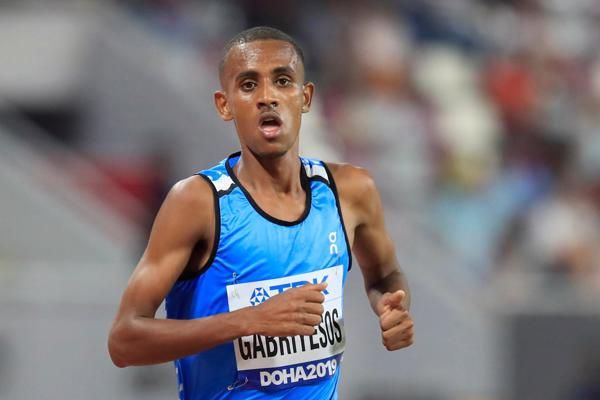
Tachlowini Gabriyesos competes at the World Athletics Championships Doha 2019 (© Getty Images)
In the lead-up to World Refugee Day on 20 June, members of the Refugee Olympic Team will be sharing their stories in a series of features as they prepare for the Games in Tokyo. The series continues with marathon runner Tachlowini Gabriyesos.
Tachlowini Gabriyesos, newly – very newly – selected for the Refugee Olympic Team at the Tokyo 2020 Games, is a restless presence on screen as our Zoom call starts.
The 23-year-old marathon runner from Eritrea, now based in Israel, seems barely able to remain in his chair, his eyes flashing, his teeth dazzling in harmony with his bright white wireless earbuds and polo shirt. Excited.
“Congratulations, Tachlowini. When did you get the good news?”
“Wow, wow, wow …Tokyo!” he replies. “I am working very, very hard and I have expectation for myself to be a lot better than I am now.
“Now my target is to be in my best shape in Tokyo. I don’t know if it will be possible but I would like to go to altitude to train before the Olympics and to do the best I can, not just to be in Tokyo but to do a really good competition – to make history for refugees by making a very good competition in the marathon.”
On 14 March, Gabriyesos became the first refugee athlete to break an Olympic qualifying mark as he comfortably surpassed the time of 2:11:30 by running 2:10:55 at the Hahula Galilee Marathon in only his second race at the distance.
Asked if he was therefore confident about being named for Tokyo, he responds, vehemently, in the negative. Which, given the difficulties he has faced in realising a strong childhood ambition to become a runner, is hardly surprising.
“Of course, I was really scared in the last few weeks,” he says. “Also, they told us it’s not just the results, it’s where you come from and what is your story and which continent you are living in and which is your country of origin. I have been sweating all day until I heard it was official!”
While he has been established in Israel since he was 12, after fleeing his war-torn native land and journeying through Ethiopia, Sudan and Egypt before crossing the Sinai desert on foot, his experience of competing internationally has been vexed by visa difficulties.
While he was able to compete for the World Athletics Athlete Refugee Team (ART) over 5000m at the 2019 World Athletics Championships in Doha, his performance there was undermined by travel difficulties because of his visa, and he was delayed for 27 hours at an airport in Turkey.
He was due to compete at the World Athletics Half Marathon Championships in Gdynia, Poland, last October, but was unable to obtain a visa.
“Yes, it is related,” he says. “Before Gdynia I was in the best shape of my life, I was so ready to do the half marathon, but at the last minute I heard that I would not be going because of visas so it was really hard for me for a couple of weeks.
“But I think what will be will be in the end – that is my belief. So I worked hard for my Olympic goal.”
Two months after his disappointment over Gdynia he improved his half marathon best to 1:02:21 as a prelude to his marathon breakthrough.
But then Gabriyesos had already demonstrated a capacity to deal with far greater challenges than visa wrangles. As a 12-year-old, he and a 13-year-old friend escaped from escalating violence in his region.
“I decided to leave, not because I was courageous like a big man, but because I saw what was happening in Eritrea,” he says as he relives that traumatic experience. “Soldiers are coming inside houses and searching for people. I wasn’t a teenager, I was a boy, and I saw I had no future in Eritrea. I was frightened. I just left my country because it was too terrible.
Fonte original: World Athletics